

Traditionally, Christmas represents the moment of the year dedicated to some of the most elaborate and tasty dishes and recipes of Italian cuisine, from North to South. There are, in fact, some dishes that absolutely cannot be missed throughout the Christmas period. Every city and every region boasts its own specialties. In Rome the abbacchio triumphs, in Naples the eel, the capon instead is the star of the central-northern regions. In any case, traditional dishes deeply represent the cultural identity of the place of origin, and always refer to particularly “nutritious” dishes.
The Roman abbacchio
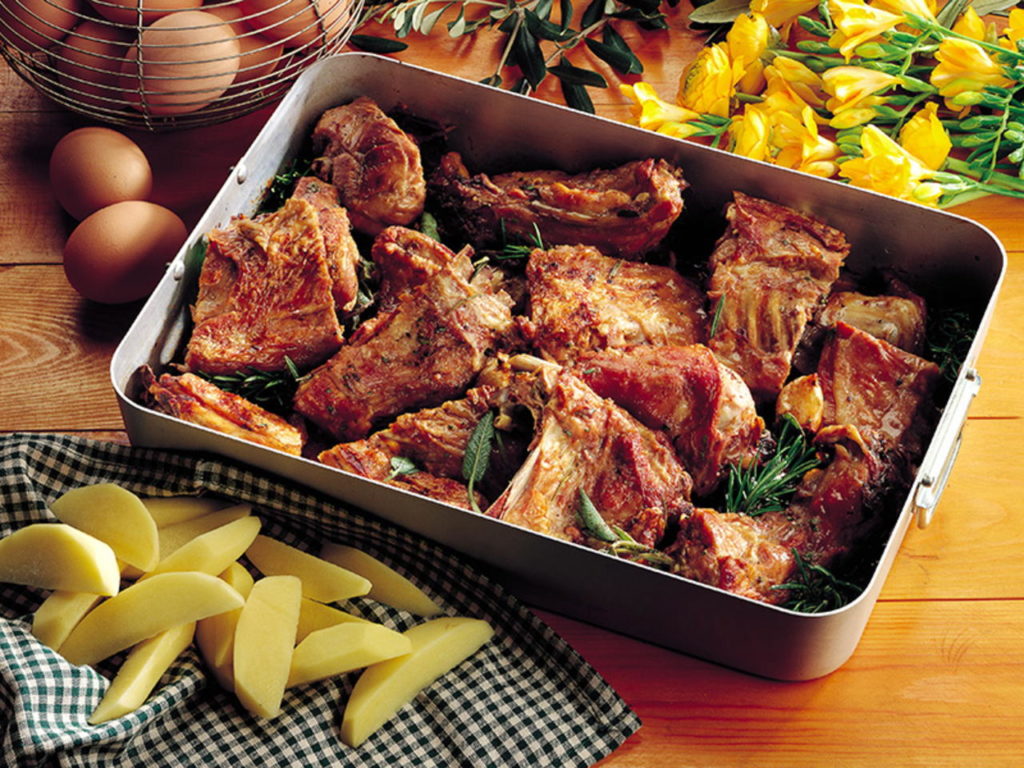
In Rome, abbacchio is a culinary synonym of Christmas (but it is also prepared for Easter). This term – which derives from the Latin baculum, or the “stick” to which the lambs were tied – indicates the very young butchered lamb, and a particularly tender and tasty type of meat. The more elaborate version, on the other hand, involves cooking leg of lamb floured and sautéed in a pan, to which sage, minced garlic and wine mixed with vinegar are then added. The meat is subsequently covered with boiling water and cooked in the oven. To prepare the abbacchio “scottadito”, served with potatoes, the lamb chops are grilled, greased with lard and seasoned with salt and pepper. There is also a fried version of lamb chops, which are first covered with egg and breadcrumbs and then fried in oil.
The New Year’s Eve capitone

What cannot be missed during a New year’s eve dinner in Naples is the capitone (from the Latin caput, testa) or the female of the eel, represented by the number 32 in the famous “Neapolitan Smorfia”. The capitone is characterized by the head and body dimensions which are bigger than those of the male eel, and it is possible to find it in both fresh and salt waters, as it usually swims up the rivers. The origin of this dish dates back to ancient times. Eating capitone – whose appearance closely resembles that of the snake, symbol of Evil – is a symbolic act of good luck that associates the birth of Christ to the elimination of evil . According to tradition, the capitone must be purchased alive the day before dinner, a period in which all the fishmongers of the city offer the spectacle of these fish swimming in large blue pools. It has to be cooked the following day, so that it is as fresh as possible.
In the Neapolitan culinary tradition the capitone is eaten essentially fried. In this case, after having gutted and cleaned the fish, it is cut into chunks and then passed in the semolina flour. Then proceed to fry until it takes on a beautiful golden color. If there is any leftover capitone, it can be used to make “capitone alla scapece”. A custom of Neapolitan cuisine to preserve fish, but also vegetables, after frying. The dish is made by marinating the capitone in oil, vinegar, garlic and mint.
The capon

Another Christmas culinary tradition, widespread in Northern Italy and part of the Central areas, is that of the capon. A gastronomic custom that dates back to the Middle Ages, when the capon broth was eaten during the Christmas holidays and, also, in relation to the Winter Solstice. In Milan, in particular, the breeding of four capons in view of Christmas represented a deeply rooted tradition, testified even by some pages of Alessandro Manzoni’s Promessi Sposi. In all four: one for Sant’Ambrogio, one for Christmas, one for New Year and one for Epiphany.
The recipe of the stuffed capon, involves the use of minced veal, or sausage, stale bread and milk, thus creating a mixture that is flavored with pepper, nutmeg, rosemary, garlic, sage and parsley, and then inserted into the capon for the filling. Once stuffed, the capon is closed using a needle and thread. Usually, baked potatoes or cooked vegetables are served next to the stuffed capon. In many cases, some sauces are combined, such as parsley, horseradish or walnut. As a good omen, tradition also wants the capon to be served garnished with pomegranate grains, one of the oldest symbols wishing fertility and well-being.