

Once, in Piedmont there was the sea. It seems absurd to believe but, although we are referring to an ancient era, it is the pure truth. Most of the plains and hills of Piedmont were, in fact, covered by a large basin full of life, characterized by plants and animals now extinct, a coral reef, tropical vegetation and numerous species of elephants, hippos, hyenas and cheetahs.
Although it has passed, now, a long time, it is possible to have an idea of what the situation was thanks to the great variety of finds and fossils found in the territory, kept in specific points open to the public.
History of the Padano Sea
The genesis of the so-called Padano Sea began about 228 million years ago, when the emerged lands of Pangaea began to drift away, letting the waters of the oceans creep between the terrestrial plates. In this way, Italy has been transformed into a great middle ground, between Africa and Europe, crossed by animals and plants to colonize territories initially distant and increasingly extensive.
About 5 million years ago, in the Pliocene, the condition of Piedmont was more or less this: the coasts of the Padano Sea bathed Turin, Monferrato was a sort of island that emerged from the waters, the Langhe formed a peninsula and between Cuneo and Alessandria there was a large gulf. This stretch of sea was named by geologists Pliocene Basin Asti.

Fonte: museotorino.it
For several millions of years numerous glaciations have alternated; at the end of the last, several glaciers have melted triggering an intense erosive activity that, accumulating many sediments, have given rise to the morainic hills and the Po Valley.
Evidence of the early presence of the sea in Piedmont are the numerous fossils of shells and the remains of crabs, sharks, dolphins and whales. In the Langhe and Monferrato, for example, various fossils and bones of elephants and rhinos have been found.
Where can fossils be observed in Piedmont?
The fossils and findings that confirm the presence of the sea in Piedmont can now be admired in different locations in the region, in particular between Asti and Monferrato, where there are protected areas, itineraries, paths and museums dedicated to it.
The most passionate can participate in guided tours, workshops and educational activities supervised by experts in the field, which also leave ample space for children and groups of classes from schools. The main points of interest are:
The Special Nature Reserve of the Andona Valley, Val Botto and Val Grande
Inside the Special Nature Reserve of Valle Andona, Val Botto and Val Grande there is one of the most famous fossil deposits in Piedmont. Established in 1985 with the aim of safeguarding and enhancing the paleontological heritage of the place, it is formed by two hilly areas located in the western part of the territory of Asti.

Fonte: astipaleontologico.it
Along the walls of the hills you can admire numerous shells and different remains of vertebrates, both marine and terrestrial, but not only: there are also many testimonies of human settlements of prehistoric times, dating back to more than 10 thousand years ago.
The Fossil Trail – Ecomuseo delle Rocche del Roero
The Ecomuseum of the Rocche del Roero includes the Fossil Trail, a circular path that can be travelled by bike or on foot; during the journey you can admire not only the remains of shells, fish and fragments of leaves, but also beautiful views and sandy walls.

Fonte: ecomuseodellerocche.it
The route passes through very different landscapes: from the woods surrounding Monteu Roero to the valley floor, among vast flat and cultivated areas, and then up through hills covered with vineyards. The route is marked by information panels that also indicate the direction of travel.
The Val Sarmassa Nature Reserve
Established in 1993 by the Piedmont Region, the Val Sarmassa Nature Reserve aims to safeguard an area particularly interesting because of its landscape heritage, which consists of a varied and unspoilt environment, characterized by hills rich in woods, cultivated fields, meadows and vineyards.

Fonte: astipaleontologico.it
At an archaeological and paleontological level, the Sarmassa Valley is part of the great Pliocene Basin of Asti, where you can admire fossils of molluscs and remains of marine mammals now disappeared.
The Belangero Ponds Nature Reserve
The Belangero Ponds Nature Reserve is located in Asti, on the right bank of the Tanaro River. It consists of a plain full of ponds, swamps and very humid environments that prove to be the ideal habitat for a large number of animals, including the newt Triturus Carnifex and the toad Bufo Viridis, two endangered amphibians.
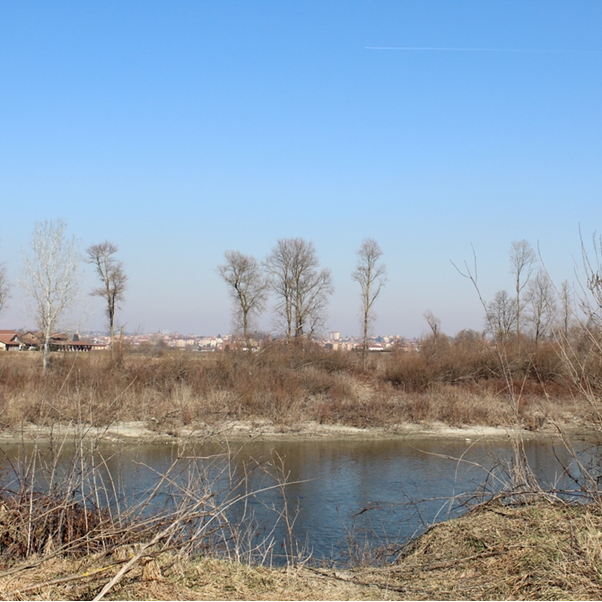
Fonte: astipaleontologico.it
In this area, in 2003, was found the fossil of a large delfinide, resurfaced following a lowering of the waters of Tanaro: it is an adult animal, about 2.5 meters long, whose remains are currently exposed at the Paleontological Museum of Asti.
The Territorial Paleontological Museum of Asti
Founded in 2013, the Territorial Paleontological Museum of Asti collects important geo-paleontological finds of the last 25 million years, especially shellfish shells, skeletal remains of huge mammals such as dolphins and whales and an aquarium that reproduces the ancient ecosystem of the Padano Sea.

Fonte: astipaleontologico.it
The museum’s collection contains about 14,000 fossil specimens, divided by locality of origin, To which are added other finds of marine mammals such as the Whale of Valmontasca and the Dolphin of Settime and witness the incredible history of our most remote past.
Copertina: monferratontour


