

A magical and almost fairy-tale atmosphere guards the wonderful Castello d’Arcano Superiore, in Friuli Venezia Giulia. Built in the twelfth century, the elevated position also contributes to its charm, in fact if initially, the castle stood near the church of San Mauro, on the banks of the river Corno; then for the need of a defensive and strategic nature, has been rebuilt where it is currently located in a raised and more isolated site. The appearance it has today is due to the structural extensions to the thirteenth century.

Fonte: turismofvg.it
The Upper Arcane Castle, still inhabited today, still retains its majestic, typically medieval appearance, with crenellated curtains to the Guelph, the double tower and the mighty keep that, on top, shows a row of elegant late-Romanesque mullioned windows. Inside, however, you can admire a room frescoed by Andrea Urbani and various areas created by Raffaello de’ Raffaelli.
History and origins of the Upper Arcane Castle
The history of this beautiful castle dates back to 1161, when the emperor Otto II granted to a certain Leonardo of Bavaria, belonging to the royal family of Croatia, some hectares of land extended from Ponte Pieli to the valley of today’s Arcano Inferiore.
It was Leonardo who first built the castle near the church of San Mauro; since the latter was located on the banks of the river Corno, the founder decided to call himself “Leonardo di Corno”, adopting as his coat of arms the one of Croatia (a shield still decorated with the white and red chessboard).

Fonte: friuliveneziagiuliasecrets.com
Later, the castle was damaged several times by the invasions of the Hungarians; therefore, while one of Leonardo’s sons, Bertoldo, decided to stay and live there, the other son, Ropretto, choose to move to a fortified residence higher up and strategically safer. The current castle coincides with the residence of Ropretto which, self-renamed Ropretto di Tercano (then Tricano), adds to the family coat of arms three greyhound dogs as a symbol of loyalty to the Patriarch, the Pope and the Emperor.
Although this loyalty is waved, however, it is not respected: the family, in fact, participates in the conspiracy against Patriarch Bertrando, killed in 1350. As a sign of revenge, Patriarch Nicolò of Luxembourg ordered to raze the residences of all the conspirators, including Bertoldo di Corno. As a result, from that moment on only one castle remained, the one “above”.
The legend of Todeschina
According to an ancient legend in 1634, the wife of Francesco d’Arcano, the Countess Todeschina of Prampero, was brutally killed. It is said that she was not much loved by the family because of her rebellious and violent character, cause of perennial clash with her husband; following a furious quarrel erupted out of jealousy, in fact, Francis stabs his wife, leaving her agonizing on the floor. The latter, before exhaling his last breath, seems to have carved with blood his initials, TP, remained well visible until the earthquake of 1976. But not only that, because with blood he would also have written the date, 1635 which, until the sixties, still appeared above the doorframe of the room in question.
After the murder, Francis would have decided to hide the corpse by wall in a wall of the castle; not to lose the dowry, he would have squandered every single penny to beautify, decorate and renovate the castle.
It seems that during the renovation works in the middle of the last century, female remains that had been walled up in an unknown period were found.
The structure of the Upper Arcane Castle
The castle has a single entrance, where initially there was a drawbridge.
Once past the thick walls you will reach a beautiful summer depandance on the right, while on the left you climb inside the building, which still retains its rooms.
The first is the dining room, entirely frescoed by Andrea Urbani with hunting scenes and various references to the classical arts; then you come across the ballroom, furnished with a long and rectangular table, a fireplace with the coat of arms of the Arcano and, on the walls, portraits of Count Francesco d’Arcano and his wife Todeschina Di Prampero.

Fonte: friuliveneziagiuliasecrets.com
Other eighteenth-century frescoes by Andrea Urbani decorate the rooms, along with some paintings depicting members of the Arcano family.
Even today, for its extraordinary beauty, the Upper Arcane Castle is coveted for any type of event thanks to the high capacity that its indoor and outdoor spaces allow.

Fonte: friuliveneziagiuliasecrets.com
What to see in Rive di Arcano
Rive di Arcano, which houses the Castello d’Arcano Superiore, is located in the province of Udine; it is a small town quite isolated, in addition to the beautiful building just described, contains other places and attractions really remarkable.
Pieve di San Martino Bishop
The Parish Church of San Martino Vescovo is not far from Rive di Arcano, precisely in San Martino. Once, a small private chapel stood on the site, enlarged at the end of the eighth century and rebuilt between the fifteenth and sixteenth centuries.

Fonte: wikimedia.org
The last restoration, which took place in the eighteenth century, gave the building its current appearance. For many years the church remained closed and unused, and only at the end of the nineties, under the direction of the sacristan Sbaizero Mario Ugo, a group of faithful restored and cleaned the interior allowing the use of the premises for religious services.
Church of San Mauro
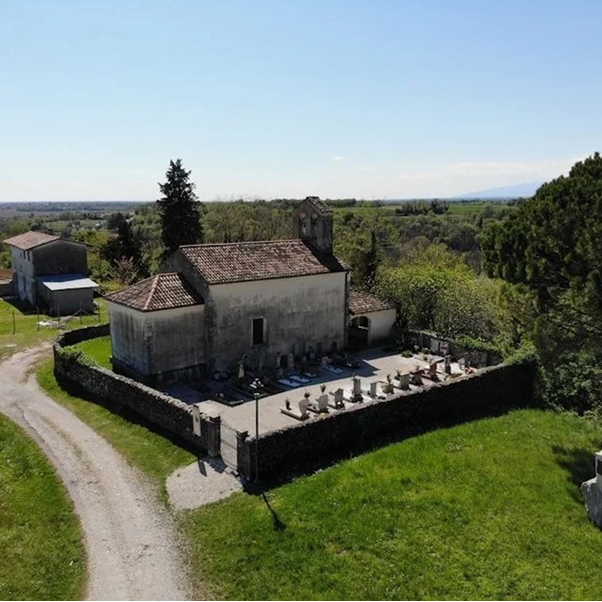
The Church of San Mauro is located on the banks of the river Corno, not far from the Castle of Arcano Superiore; it is surrounded by a small stone wall that contains the old cemetery. It was born as a devotional church, to which the family of Arcano was very attached.
Fonte: comune.rivedarcano.ud.it
Its construction dates back to the sixteenth century and its structure consists in the extension of a previous church, of which numerous frescoes have remained. Towards the end of the fifteenth century the Turks completely destroyed it, as well as the earthquake in Friuli at the end of the twentieth century but, in both cases, the church was restored and reopened to the public.
Church of Sant’Andrea Apostolo
The Church of Sant’Andrea Apostolo is located in Rodeano Alto; its construction is of the eighteenth century, but there were several extension works carried out during the nineteenth century.

Fonte: wikimedia.org
Although the earthquake of 1976 considerably damaged it, at the end of the eighties a restoration and consolidation work was carried out to restore its external beauty and internal artistic heritage.
The church was damaged by the 1976 Friuli earthquake and, therefore, in 1982 it was restored and consolidated.
Copertina: altervista


