

Together with the chestnuts and the pomegranates, the typical fruits of the fall are persimmons which come from Diospoyros kaki, a fruit plant from East Asia belonging to the the family of the Ebenecee. The persimmon in Italy was introduced in 1880 and the success was extra-ordinary. Among the firsts to appreciate it was also Giuseppe Verdi who in 1888 wrote a letter where he thanked the person who gifted them.
The first specialized facilities came up in the area of Salerno, in particular in the Agro Nocerino, then extending to Sicily and then in Emilia-Romagna. In Italy the production has stabilized around 65,000 tonnes: the crops are sporadically located all over the country but it is important only in Campania and Emilia-Romagna which on their own represent 90% of the Made In Italy production: the remaining 10% is grown in the other Italian regions.
Since the plant is rustic and resistant to parasites is ideal to be grown in a domestic orchard, where every single trees can give a lot of satisfaction.

When and how are they consumed in Italy?
The best period to enjoy these fruits is between October and December when the temperature is lower. Generally you consume them fresh, getting the pulp with a spoon. Thanks to their smoothness and sweetness, they are ideal to prepare mousse, jams, pies and cobblers
The most pupil at varieties are:
- Loto di Romagna
- Vaniglia della Campania
- Cachi di Misilmeri
- Fuyu
- Kawabata
- Suruga
- Cioccolatino
Quality and nutritional values of persimmons
The fruit is 82% water and contains 65-70 kcal for every 100 g; it also has a lot of soluble sugar, mainly fructose and glucose.
It is rich in minerals (sodium, potassium, calcium and phosphorus), vitamins (A and C), tannins and a decent amount of fibers, about 3,6% while fats and proteins are almost entirely lacking.
The presence of vitamin A helps keep skin and eyesight healthy while vitamin C helps with the immune defense. For this reason, persimmons are useful to make the body more resistant against viruses and bacteria especially during the fall winter period.
Persimmons are also recommended for those who practice sports or people who are about to be under a lot of stress both mentally and physically, this is because they are highly energetic fruits rich in mineral salts. But be careful. Due to its high nutritional values it is not recommended an excessive consumption to those who follow a hypocaloric diet or who have diabetes.
Persimmons have a lot of properties such as diuretic, laxative and and anti-oxidant. The anti-oxidant activity of this fruit seems due mainly to the high molecular weight tannins. Furthermore, some studies have highlighted how tannins can reduce the risk of heart diseases, hypertension and some kinds of tumors.
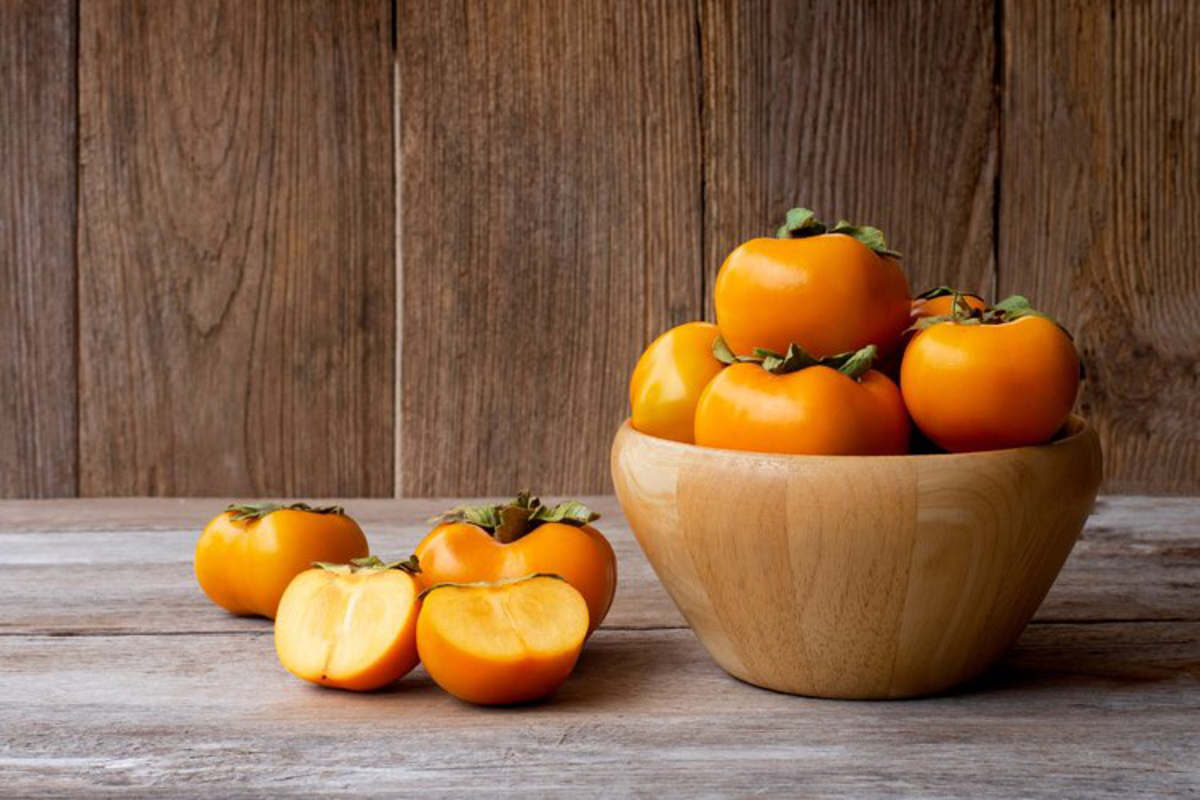
How to recognize the right ripening of persimmons
Being a delicate fruit one it needs to be picked with caution at the right time.
Even if you want to let the fruit ripe off the tree you should avoid picking them when they are still green, better to wait for the peel to turn completely yellow. In this phase the persimmon is still unripe but formed, and it is hard to the touch.
he fruit is ripe when the peel is of a bright orange color and it is soft to the touch, so much so that you might risk squashing it and end up having your fingers covered in pulp!
Fun facts: how is the persimmon called in the different Italian regions?
Persimmons are commonly called in the Naples area “legnasanta” (holy wood). The origin of the name stands in the fact that once the fruit is open you can see inside a typical image of Christ on the cross.
In Sicily, on the other hand, the seed is to be considered sacred for if split in two shows the bud of the new plant, which looks like a white ethereal hand, considered to be the “manuzza di Maria” or “dâ Virgini” (the hand of Mary or of the Virgin).
In Tuscany it is referred to with the form derived from the Greek “diòspero” while in Emilia-Romagna the persimmon is called “loto”.

Cover Image : naturasi