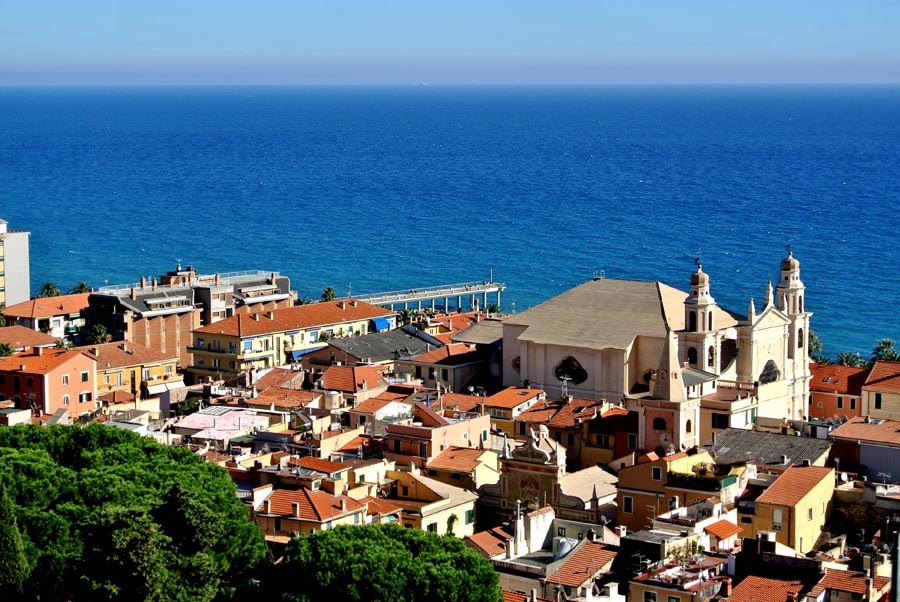
Among the hills of the Ligurian hinterland, stands Dolceacqua, one of the most picturesque villages in Italy that fascinates visitors with its fabulous setting and its timeless atmosphere.
Dal web
Dolceacqua is a town located in Liguria, in the north-west of Italy, more precisely in the province of Imperia, halfway between Ventimiglia and Bordighera in the heart of the Nervia Valley.
This picturesque town stands among the hills of the Liguria hinterland, not too far from the Ligurian Sea coast. Its strategic location, between mountains and sea, contributes to its charm and natural beauty.
The origins of the village of Dolceacqua
Divided between the ancient part, with the majestic Doria Castle overlooking Mount Rebuffao, and the modern village that extends across the river Nervia, Dolceacqua contains a rich history of nuances.
The name of the village explains why it is called “Dolceacqua”: it draws its roots from an ancient Roman settlement called “Dulcius” that has evolved over the centuries in “Dulcisaqua”.
The traces of the past of the village are revealed through archaeological finds of ancient fortifications made of dry stone and the presence of a tower in the area of the Alpicella, indicating a garrison of the Ligurian tribe Intemeli in the Roman period.
In the twelfth century, the counts of Ventimiglia erected the original nucleus of the Castle, which became the fulcrum of successive expansions following the purchase by the Doria family.
The Doria Castle was the fulcrum of clashes during the disputes between the Guelphs and the Ghibellines and the War of the Austrian Succession (caused by the agreement of Bartolomeo Doria with Charles II of Savoy for the rights of the village).
Dolceacqua: what to see
Dolceacqua seems straight out of the genius of some artists thanks to its evocative views and its medieval alleys.
The village is crossed by the river Nervia and seems divided into two: to connect the district “Borgo” with the district called “Téra” on which stands the Castle of the Doria is a stone bridge made of donkey back.
Dal web
The Doria Castle is one of the focal points of Dolceacqua. It is an imposing structure that dominates the landscape and offers an incomparable view of the Nervia valley and the surrounding hills. Exploring its ancient corridors and towers is like stepping into the past, imagining the epic events that took place within its walls.
The main path that leads to the Castle is an experience of its own made of characteristic “carugi” (typical alleys) in which there are cellars and small workshops of artisans of local products and artifacts.
One thing to see in Dolceacqua is definitely the Visionarium, that is a space in which documentaries in 3D and 4D are projected, in addition to the Luigina Garoscio Palace (seat of the Pinacoteca Giovanni Morscio that collects the frescoes of the Dolceacquino painter and some of his figurative colleagues of the time, as well as the Small museum of the historical figurine, the Civic Library and historical archive and the Cultural Center).
Even the religious buildings are points of interest worthy of note, from the seventeenth-century Church of Sant’Antonio Abate with its ancient bell tower and baroque paintings to the Church of San Giorgio in Romanesque style.
Dolceacqua and Monet: Le Château de Dolceacqua
The uniqueness of Dolceacqua also enchanted the painter Claude Monet: the impressionist captured the unique atmosphere of the village with its picturesque bridge and the majestic castle in his “Le Château de Dolceacqua”.
Monet himself described Dolceacqua as “a jewel of lightness”, a praise that emphasizes the extraordinary beauty of this place.
Today, the municipality has installed two panels that faithfully reproduce Monet’s works, placing them at the exact point where the artist sat down to paint.
Dal web
Cuisine and gastronomy
Dolceacqua’s cuisine is a feast for the senses. The local dishes are characterized by fresh and genuine ingredients, such as olive oil, aromatic herbs and seafood.
Among the most famous specialties are michetta (traditional bread), fugasùn (rustic cake), cartelétu (meat dish of kid) and ravioli borage (stuffed pasta typical of the area).
Dolceacqua is renowned for its vineyards, from which are produced high quality wines such as the prestigious Rossese di Dolceacqua superiore and Rossese di Dolceacqua.
Dolceacqua: how to get to the village
How to reach Dolceacqua depends on the means of transport chosen to reach the Ligurian village from the starting point.
If you are traveling by car then you need to take the A10 motorway to the west towards Ventimiglia, continue on the A10 until the exit Bordighera or Ventimiglia, take the S.S. Aurelia and continue on the provincial road of Valle Nervia.
Those travelling by train must take a train to Ventimiglia (nearest railway station to Dolceacqua) and from there continue with a bus service.
If you prefer the plane, considering that the nearest airport to Dolceacqua is Nice Airport (Aéroport Nice Cote d’Azur) in France, you must continue by train or rent a car once you arrive at the airport. From Nice, take the A8 eastbound towards Italy, cross the border at Ventimiglia, continue on the A10 and follow the signs for Dolceacqua.
Dal web
Where to sleep in Dolceacqua?
Dolceacqua has a wide range of options for hospitality, whether you are looking for a cozy bed & breakfast or a holiday home.
Those who want a more authentic experience can opt for one of the farmhouses that offer a direct connection with the local culinary tradition.
Copertina dal web