
After 33 years of waiting, a number that in the Neapolitan Grimace represents the years of Christ, Naples becomes Italian champion for the third time in its history. The victory of the team of Luciano Spalletti, and the immense joy of all the fans who followed the game was certainly accompanied by superstitious rites, so important in the city of Vesuvius.
For example, many, during the game, will have certainly stroked the hump of the “scartellato”, a curious character and typical of Neapolitan culture; It would, in fact, the ability to drive away the evil eye and bring luck to anyone who touches it.
The discarded, or hunchback, has such an important role for Naples that it even appears in the Grimace: its number is 57, among the most fortunate. Attention, however: to be a symbol of good omen must be categorically a man; the hunchback woman, in fact, is considered a carrier of misfortune and suffering.
Let’s better investigate the origins of the waste and the characteristics it must have to wish only the best!
fanpage
History of the gap between myths and legends
The origins of the scartellato date back to the Middle Ages, a time when everything that could not be explained scientifically expired in mystification. In a nutshell, since the theocentric view was predominant, everyone placed religion above and at the center of everything.
As a result, any event capable of arousing wonder and surprise was considered a divine sign; among these, even individuals with humps. It was thought, therefore, that touching the curve present on the back of these people brought a lot of luck and was a good omen. According to the beliefs, in fact, the hump would have hidden a basket full of precious goods so, the mere fact of being able to touch it, amounted to grab a part.
Fanpage
This, however, was only valid if the hump belonged to a man; in case you had come across a hunchback woman, on the contrary, it was recommended to stay away from her as bearer of “jella”, or bad luck. It was thought, in fact, that the anomalous curvature derived from direct contacts with the devil and it was therefore necessary to have nothing to do with it, indeed, it was common to avoid even just to cross the looks.
Origin of the name
As for the origin of the name, it is highly probable that “scartellato” comes from the Greek “kurtòs”, that is curved or arched, a position assumed to carry on the shoulders several heavy objects (in this specific case, as mentioned above, a basket full of precious goods).
It could, however, also derive from the Latin “cartellum, cartellus” (in Naples the language is a mix of Latin, Greek and Lombard terms), therefore “discarded” would not indicate a deformity but, rather, the symbol of an immense fortune.

vesuviolive
How to get lucky from scrap
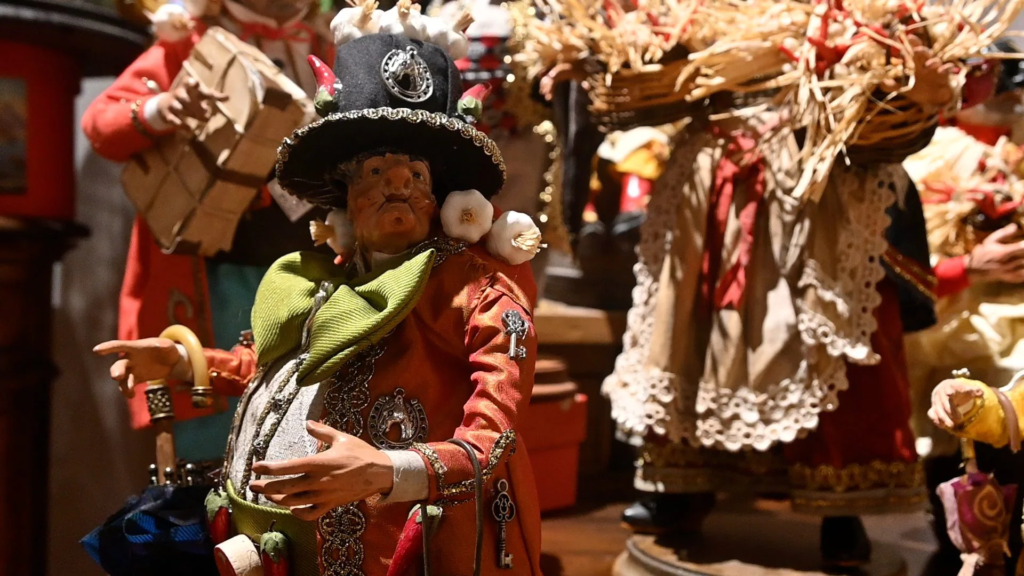
The scartellato is a real mythological character and is instantly recognized: he is a man dressed in a black jacket, red bow tie and black cylinder on his head. It is possible to buy it (and admire it) in any shop in Naples, usually combined with another essential symbol: the red croissant.
Anyone looking for a good deal of luck, therefore, must simply wander around the Neapolitan shops looking for a scrap, but beware: to make sure that it really brings only beautiful things, must be categorically given and must be equipped with a very curved horn (discarded, in fact), bright red, with which the donor must sting the hand of the recipient.
In short, a real superstitious ritual that must be performed to perfection, keeping in mind one of the many Neapolitan sayings (which, in this case, fits perfectly): “Not true, but I believe”.
The Neapolitan horn, hand in hand with the discarded
The symbol of good luck par excellence of Naples is, without any doubt, the horn. In the city you can find it everywhere and it is so deeply rooted in Italian culture that it is a gift and coveted in any part of the peninsula.
To understand its true meaning, it is necessary to make a very long time jump and go back to prehistoric times, since the cult of the red cornet is connected even to the men who lived in the caves in 3500 B.C. At that time, It was common practice to hang the horns of animals killed at the entrance of caves as a symbol of power and protection, as well as as as a way to flaunt their strength and, consequently, to demand respect for their deeds from other tribes.
This tradition has been handed down over time: just think of the Vikings, who wore large horns on their helmets just to prove their value and inspired the population to create small horns lucky with poor materials such as terracotta and wood.
And it is not over, because to the historical tradition is also added a more spicy and mischievous version about the birth of the Neapolitan “curniciell”: according to legend, the horn would represent the phallus of Priapus, the God of prosperity who, For the Greeks, he was the greatest protector of bad luck. Not surprisingly, various symbols of this type were found during the excavations of Pompeii and Herculaneum.

eccellenzemeridionali
How to choose the real Neapolitan horn
If you want to have a real Neapolitan good luck horn is essential to choose it for good; to be a real amulet, in fact, must have the following characteristics: tuosto, stuorto and cu ‘a punta (ie rigid, crooked and equipped with tip). But not only, because it must also:
- be made entirely by hand, so as to be able to absorb the positive energies of the craftsman who, subsequently, will protect from bad luck;
- be red as blood, synonymous with life;
- always be given and never bought, otherwise it would lose its protective functions.
Once donated, or received as a gift, the Neapolitan horn must be activated following the ritual described above: the giver must prick the open palm of the receiver’s left hand with the tip of the horn itself.
In the event that the tip of the horn suddenly breaks, we should not panic, on the contrary, it is positive: it means that the cornet has performed its function correctly, so it has absorbed the negative energies in its tip that, once it fills, it is obviously broken. All normal, then!
To conclude, here is a phrase of the famous Eduardo de Filippo who, with very few words, manages to best express what has been told so far: “Being superstitious is ignorant, but not to be bad brings”.
Copertina: 21secolo