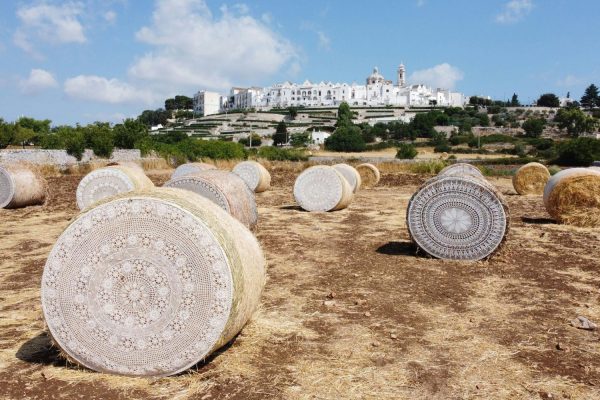
Monte Sant’Angelo and the Gargano
On a spur of the Gargano, surrounded by woods, stands Monte Sant’Angelo, a mystical city and precious in many ways, awarded two different UNESCO awards. It has an ancient history, made up of religions and cultures that for millennia have clashed and succeeded.
Protected for centuries, according to tradition, by the immaculate wings of the Archangel Michael, it boasts an artistic and cultural heritage of all respect but also a special relationship with the nature that surrounds it.
Monte Sant’Angelo in history
The origins of Monte Sant’Angelo date back to the pre-Roman period, when it was inhabited by the Italian people of the Dauni.
The first appearance of the Archangel Michael is dated, according to the myth, 8 May 490: it is said that he appeared to the bishop of Siponto Lorenzo Maiorano ordering him to dedicate a cave to Christian worship. In 493 AD, according to tradition, the Archangel Michael appeared again on Mount Gargano announcing his will to protect the city from the imminent barbarian invasions.
Thus the foundations of the Sanctuary of San Michele Arcangelo were laid, one of the most important places of pilgrimage since the Middle Ages and still a destination for intercontinental journeys of the faith.
During the Renaissance and the Modern Ages it experienced periods of prosperity but also of decline because of the wars and epidemics that hit the region. However, the Shrine of Saint Michael continued to attract pilgrims from all over the world.
The village on foot
Monte Sant’Angelo is a delightful and white town, a natural balcony with a splendid view of the Adriatic Sea, which often, seen from here, appears adorned with equally white clouds.
As you advance through the narrow streets of the village you are enveloped by an ethereal atmosphere thanks to the small white houses, all close and tidy, and the absence of car traffic. At every corner there are artisan workshops specialized in sacred objects, which must be at least half of the city’s economy.
The beauty of Monte Sant’Angelo is manifested in its historic center but also in everything that the area offers: in the suggestive Norman-Swabian-Aragonese Castle, in the Grotto of the Sanctuary dedicated to the Archangel Michael, in the mysterious Baptistery of San Giovanni in Tumba, in the Church of Santa Maria Maggiore with its frescoes, in the woods and in the coastline.
Territory and landscapes: the “magical” woods of the Gargano
From its 843 meters above sea level, Monte Sant’Angelo dominates the Puglie table, with a panoramic view of the towns that from the Gulf of Manfredonia to Bari overlook the Adriatic Sea.
The surrounding landscape is dominated by pastures, olive groves and woods: starting from here, unpublished and unknown nature trails to most. There are more than 500 kilometers of walking through the green lung of Puglia, demonstrating that hiking, hiking, bird watching and nature tours are not only the preserve of certain regions of northern Italy.
Going down from the village towards the Carbonara Valley and then again going up towards San Giovanni Rotondo a small road on the right leads into the depths of Bosco Quarto, which for extension and naturalistic importance is second only to the Umbra Forest.
Along the walk you can admire some of the most monumental oaks of the Gargano, whose trunks look like columns that have taken on the task of holding the sky. The maples and beeches that accompany them are dressed in the most vivid colors with the arrival of autumn, while at their feet it is easy to come across mushrooms, which are easily found here thanks to the rarefied undergrowth. The tree level dominates all the vegetation because of the very frequent cattle grazing.
The scenario changes then suddenly encountering karst phenomena, when the Gargano shows its face more rugged, lunar and melancholic, therefore -for this- beautiful. The sinkholes, dotted with woodland, follow one after the other while the air resounds with the presence of a very rich fauna: you can meet, in fact, the Wild Cat, the Wild Boar, the Tawny Owl, the Woodpeckers and the Thrush. Reports not entirely confirmed assume episodes of nesting of the Owl.
The Umbra Forest, awarded in 2017 the title of UNESCO World Heritage for its ancient beech forests, is known to be a real biodiversity heritage, the subject of studies for its vegetation characterized by plants of exceptional size (phenomenon known as “macrosomatism”).
Despite the deforestation the forest has in fact preserved almost completely its rich vegetative tissue. It is home to over 2,000 plant species, with beech trees reaching heights greater than 40 meters and diameters greater than a meter.
The highest part is dominated by broad-leaved trees, including white and black hornbeam, maples, oak and holm oak. At lower altitudes extend the beech woods, which go down to about 270 meters above sea level. In the undergrowth there are several species of herbaceous plants, including numerous types of orchids, anemones, violets and cyclamens.
The Forest is walkable through 15 paths made by the State Forestry Corps: each is equipped with wooden tables that indicate the starting point and arrival and the estimated time to complete the route. Vieste and Vico del Gargano are excellent starting points to discover this extraordinary natural treasure.
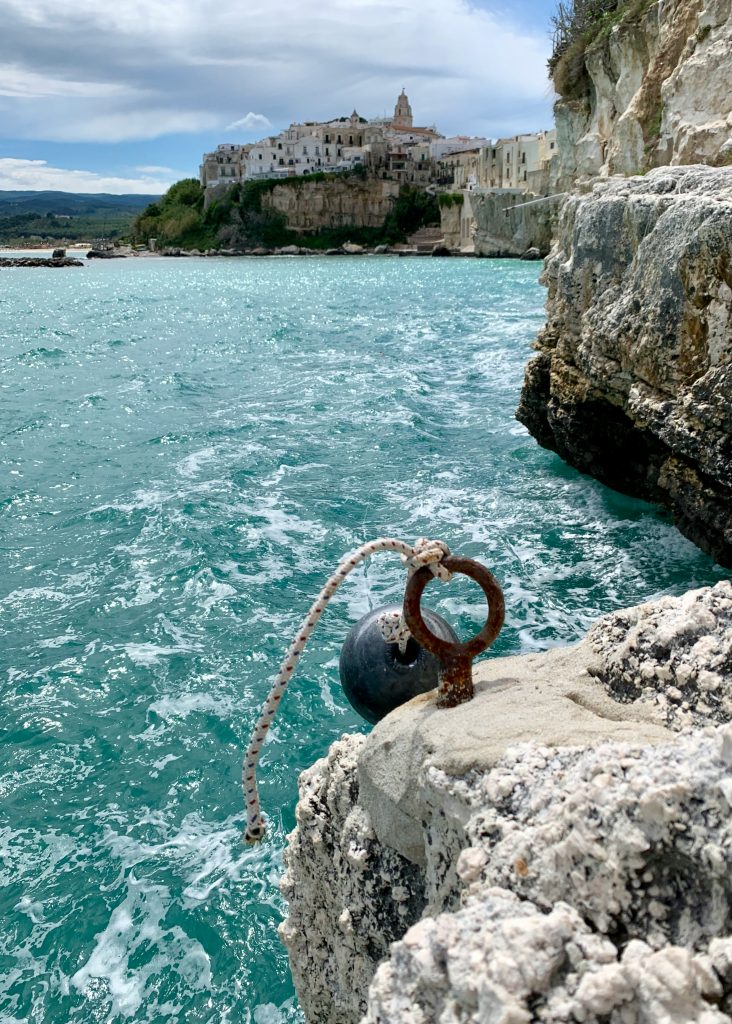
Foto : Unsplash
Short gastronomic guide of the Gargano
Who visits the Gargano does not give up, usually, to bring home the religious souvenirs produced with skill by the artisans of Monte Sant’Angelo, but also another type of memories, purely gastronomic. They give to friends and relatives, for example, Apulian delicacies such as taralli, orecchiette, troccoli and caciocavallo.
Even olive oil has always been a prestigious protagonist of the Gargano table, which is revealed in all its excellence when served simply, in addition to the flavors of the peasant tradition: for example with bread and broad beans or in the bacon seasoned with wild vegetables.
It may come as a surprise, but Gargano’s cuisine is not so much rooted in maritime tradition as in inland meat recipes. Lamb, kid, pork, rabbit and goat ragout explode in taste in combination with asparagus, lampascioni, eggplant, artichokes and wild capers.
Among the gastronomic excellences not to be forgotten when you pass by these lands we find: the Citrus Gargano, the bean of Hornbeam, the Caciocavallo podolico (obtained from the milk of the cow Podolica) and the Garganica Goat.
The sea also influences the flavors and in fact among the most recommended gastronomic experiences we recommend the dinners based on the catch of the day on the Trabucchi, the ancient fishing platforms built by pulling on poles, pulleys and pylons.
Looking at the sea straight inside the blue of his eyes you can then enjoy sea bream and mullet cooked in a pan or grilled, as well as the famous mullet of Manfredonia -fried or in foil- seasoned with the juice of the lemons of Gargano.Monte Sant’Angelo and Gargano, blessed lands.
Autore: Eleonora Di Mauro
Copertina: Unsplash