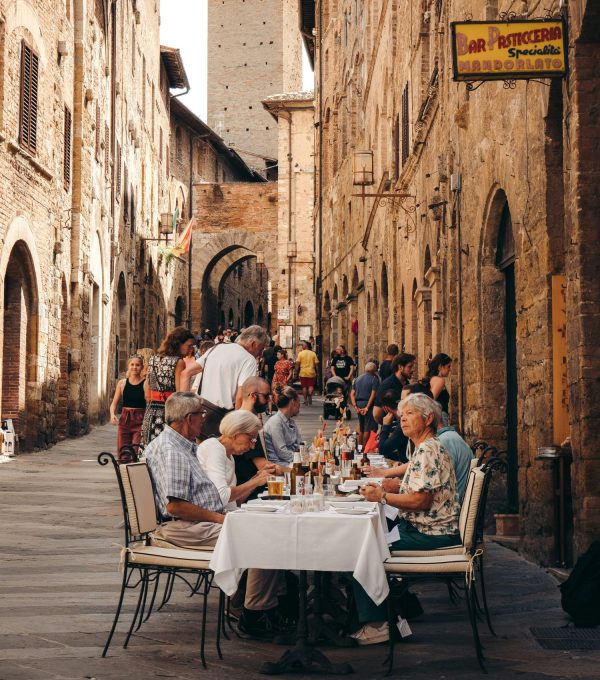
From September 10th to 13th, the Tuscan town celebrated the thirtieth edition of the the celebration cellars. Four days of wine, Maremma cuisine, music, horses, and collective memory that told more than a food and wine event: the relationship still alive between a community and its traditions.
For four evenings the doors opened and the historic center returned to being a large common home. Inside there were tables, glasses of wine, traditional dishes, people sitting next to each other. Outside, in the alleys of Manciano, the movement of those passing from one cellar to another continued. This was, once again, the most authentic image of the Cantine Festival, which celebrated its thirtieth edition from September 10th to 13th. Thirty years is not just a celebration. For a popular festival, they represent a much more interesting measure: that of the ability to resist change without losing the connection with the place where one was born.
Manciano, in the heart of the Maremma
To understand the party you must first look at Manciano. We are in the southern Maremma, in the province of Grosseto, in an area where the Tuscan hills are slowly beginning to look towards Lazio. The village occupies a dominant position and from the highest part the view opens onto a vast countryside, built of olive groves, vineyards, pastures and woods. The Cassero, of Aldobrandesca origin, still dominates the town. Not far away are Montemerano and Saturnia, with its famous thermal waters. But during the Cantine Festival the observation point changes. You don’t just come to see Manciano. You enter the country.
A party born in 1994
The history of the event began in 1994, when the Pro Loco of the time created what would become one of the most heartfelt anniversaries in the country. Since then, the Festival of Wineries has grown, spanned generations and inevitably changed. In 2026 it reached the symbolic milestone of its thirtieth edition. To celebrate it, the opening on Thursday, September 10th was entrusted to memory. Photographs and images from past editions were projected in Piazza Garibaldi. Younger faces, tables, old evenings, people who have worked on the event over the years. It was not a minor detail of the programme. It was probably the most correct way to start. A folk festival exists as long as a community continues to recognize itself in its history.
When the cellars come back to life
The heart of the demonstration remained the one indicated by the name. The cellars. Every evening the historic center opened its spaces, transforming them into places of conviviality. The wine was accompanied by traditional Maremma dishes, music, and above all, the opportunity to be together. This is the element that distinguishes an authentic village festival from a simple gastronomic event. It is not enough to serve local products. We must maintain a relationship with the spaces, people and memory of the place. In Manciano, the cellars have once again become small tables scattered throughout the historic center. The visitor did not have a single exhibition space in front of him. He had to move. Entering an alley. Go down a few steps. Stop. To start again. The festival thus coincided with the geography of the village.
Wine as the language of the Maremma
Of course there was wine. But it would be wrong to read its presence only through tasting. In this part of Tuscany, viticulture belongs to a larger agricultural landscape, along with olives, livestock farming, and dairy production. The Manciano area is also located in the Tuscan Maremma area, which has acquired increasing oenological recognition in recent decades. Drinking a glass during a party like this therefore means meeting a component of the local economy and culture. Before being produced to be told through a technical sheet, wine was for centuries part of the daily table and collective occasions.
A kitchen that doesn’t need to dress up
Alongside the wine, the flavors of Maremma cuisine have returned. It is a cuisine born in an agricultural and pastoral area, historically built on the availability of ingredients and the need not to waste. Hearty dishes, sheep’s cheeses, oil, meats, pasta, and family preparations belong to a gastronomic heritage that still retains a clear relationship with the countryside. Among Manciano’s signature specialties is ciaffagnone, a subtle and ancient preparation, similar in appearance to a crepe, linked to local tradition. It is precisely these dishes that give meaning to demonstrations like this. A territorial festival becomes interesting when it offers what would be difficult to find, in the same way, elsewhere.
The Night of the Horses
Then came the horses. On Thursday evening, Manciano rediscovered one of the most evocative moments of the event: the traditional torchlight procession on horseback. The procession started from Via Martiri della Libertà and crossed some of the town’s main streets. The drummers and ox cart of the Badia Vecchia Company paraded in front of the knights. In the darkness, torches brought Manciano back for a few minutes into a deeply Maremma-esque imaginary. Here the horse is not a decorative element inserted to make a party more picturesque. It refers to the rural culture of the area and to the figure of the buttero, one of the most recognizable symbols of the Maremma.
The buttero and a Maremma that still exists
For a long time the buttero worked on horseback, tending herds on large estates and in the Maremma countryside. He has become an almost legendary figure, often superficially compared to the American cowboy. But the buttero belongs to its own history, linked to the environmental conditions, livestock farming, and agricultural organization of central Italy. Today that world has profoundly changed. Yet horses, traditional riding, and equestrian culture continue to represent an element of Maremma’s identity. A torchlight procession through the streets of the village keeps this relationship alive without the need to transform it into a museum reconstruction.
The religious festival behind the popular festival
Then there is an element that risks taking a back seat when wine and music prevail. The Cantine Festival takes place as part of the celebrations dedicated to the Holy Crucifix. On Sunday, September 13, the Mass of the Holy Crucifix was celebrated in the church of San Leonardo. It’s a typically Italian overlap. Sacred and popular coexist in the same calendar. Religious celebration, the table, music, the market, and the meeting between people belong to different dimensions but have historically grown within the same community idea of the festival.
Via Marsala and the markets
From Friday to Sunday, Via Marsala also participated in the event, with markets open since the morning. Crafts, gastronomy, and products have extended the festival beyond the evening hours of the wineries. It is an important aspect because it allows the event to involve the country throughout the day and creates opportunities for visitors, traders and producers to meet. A territorial demonstration really works when its impact does not remain locked within the event’s enclosure, but enters the daily economy of the place.
Thirty years means generations
The most interesting data from the 2026 edition, however, remains number thirty. A person who attended the first Cantine Festival in 1994 as a boy may have returned this year with their children. Those who worked at the organization then today can observe younger generations taking care of the same spaces. This is how a demonstration becomes tradition. Not because it’s very ancient. But because it manages to be transmitted. Thirty years is enough to create family memories, habits, and expected dates. The question then becomes inevitable: why do some parties survive and others disappear?
The community before the event
The answer probably lies in the community. An event can have a large communication campaign, important guests and large numbers, but if the inhabitants no longer recognize it as their own it gradually loses its meaning. Village festivals operate according to a different logic than large festivals. Much of the work happens before visitors arrive. There are people who prepare spaces, organize cellars, cook, assemble facilities, coordinate initiatives, and solve problems. Pro Loco, associations, activities and volunteers become a temporary machine that allows the town to transform itself for a few days.
Volunteering that doesn’t appear in photographs
This is perhaps the least visible part of demonstrations like the one in Manciano. We see the glass served, the plate on the table, the music and the procession. We see less of the hours spent preparing. The thirtieth edition therefore also offered an opportunity to remember those who, over the years, have contributed to the continuity of the festival. The Municipality itself emphasized the role of the Pro Loco, the wineries, the associations, and the people who worked edition after edition. Behind a tradition that seems to repeat itself spontaneously there is almost always an enormous amount of voluntary work.
The historic center returns to having a function
Then there is an urban and cultural aspect. For four days the historic center was not simply something to observe. It has returned to heavy use. Cellars, alleys and squares have recovered a social function. It is a particularly important topic in small Italian towns, many of which face problems of depopulation, aging, and the progressive loss of commercial activities. Events cannot solve these phenomena alone. However, they can remember that a historic center remains alive only when it is inhabited, crossed and used.
A door on the Maremma
The festival was also an opportunity to discover the surrounding area. Manciano is an ideal location for understanding the southern Maremma. A few kilometers away is Montemerano, a medieval village clustered around its square and stone streets. A little further away are Saturnia and the thermal waters that have made this part of Tuscany known to the world. Then come Pitigliano, Sorano and Sovana, the cities of tuff, with their Etruscan and medieval heritage. Those who arrived for an evening in the cellars therefore had the opportunity to transform the party into a multi-day journey.
The Maremma which is not just a landscape
For decades, the Maremma has been told through powerful images: butteri, horses, countryside, spas, tuff villages, vineyards, and olive groves. All true. But the risk, when a territory has such a strong imagery, is to turn it into a postcard. Popular festivals help correct this perspective because they show that a community still exists behind the landscape. The Maremma is not just something to photograph. It is an area where people work, organize parties, produce wine, raise animals, grow olive trees, and continue to grapple with the contemporary problems of the inland areas.
Tradition does not mean immobility
In thirty years, the Festival of Wineries has inevitably changed. The 2026 program showed this clearly. Alongside the torchlight procession and religious celebration, there was space for performances, markets and contemporary music. On Saturday night, Piazza Garibaldi hosted the “2000 Forever Party”; on Sunday, the event concluded with a DJ set. Some might read this coexistence as a contradiction. It isn’t necessarily. A tradition lives on just when it can speak to generations who were not present at its birth. The challenge is to change without erasing the original core.
The value of Italian holidays
Manciano thus tells a much broader phenomenon. Italy boasts thousands of local festivals, festivals, religious celebrations, and events centered around agricultural products, seasons, and traditions. Not all have the same cultural value and not all manage to maintain an authentic relationship with the territory. But those that succeed constitute an important heritage. They create sociability. They transmit recipes and rituals. They bring visitors to small towns. They provide visibility to local productions. Above all, they force a community to work together for at least a few days.
After the last music is over
On Sunday, September 13th, at 11 pm, the DJ set in Piazza Garibaldi officially marked the end of the 2026 edition. Then came the dismantling, cleaning and return to normal. The cellars have closed. The tables are gone. The streets are back to what they are every day. This is perhaps the most interesting moment of any village festival: the next one. When only the inhabitants remain and you realize that for a few days the same places you pass through daily have had a different meaning.
Thirty years later
The Cantine Festival turned thirty, and the most important achievement was not simply reaching a round figure. It is still recognizable as Manciano festival. In an age when many events tend to resemble each other, maintaining a clear relationship with the place is a value. The wine, the traditional dishes, the horses, the ox cart, the celebration of the Holy Crucifix, the cellars and alleys continued to tell a story that could hardly be transferred elsewhere without losing meaning. This is the difference between organizing an event and cherishing a tradition. The first can be replicated. The second belongs to someone. From September 10th to 13th Manciano celebrated thirty years of its wineries. But most of all, for four days, she celebrated herself.