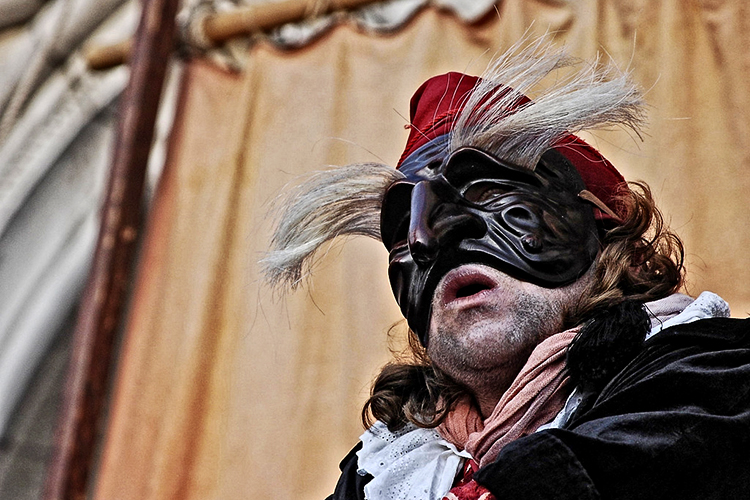
His origins go back a few centuries; he was already famous in 1568 thanks to its presence in a piece of artwork supposedly staged in the court of Bavaria. Pantalone believes that everything can be bought and sold. He loves money and spends his time chasing after young girls, and trying to marry off his daughter to a wealthy man. It was Carlo Goldoni who later toned down Pantalone’s comic aspect, turning him into a level-headed, conservative, wise old man, as seen in the comedies I rusteghi and Sior Todero brontolon.
The reasons for his name are uncertain: it’s thought that his name derives from the patron saint of Venice, Saint Pantaleon or from the expression “pianta-leone”, which refers to the act in which soldiers and rich Venetian merchants traditionally put up a flag featuring lions in every conquered or acquired territory. It has likewise been suggested that it could derive from the trousers he wore from the very beginning (in Italian, “pantaloni” right means trousers).

Characterized by an ungraceful build, his character derives from the figure of the Venetian merchant of the sixteenth century, as depicted in many Venetian, Reinassance Venetian paintings. Always loved and greatly appreciated in Venice, Pantalone represented business accumen and a flair for business, typical of the Venetian bourgeoisie who was starting to take on power during this time of change.