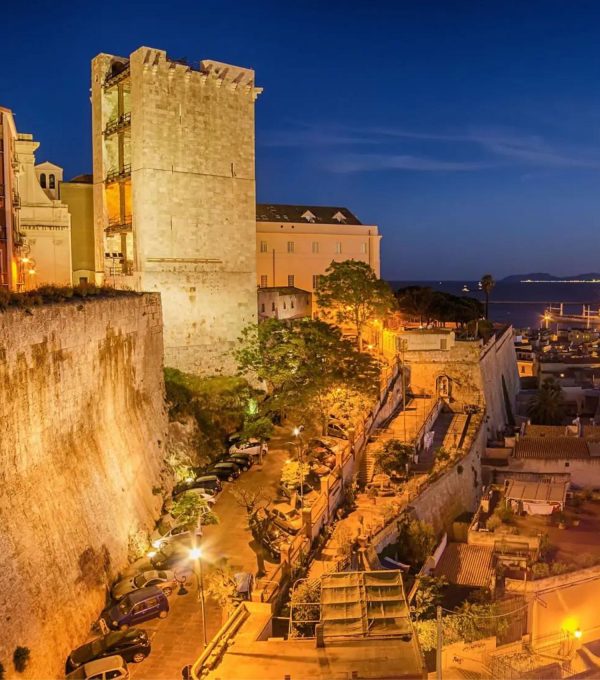
The city of Cagliari, in the beautiful Sardinia, houses a monument of great historical, cultural and spiritual importance: it is the Sanctuary of Our Lady of Bonaria, located on top of the homonymous hill, among the most important Marian buildings on the island.
The structure, in its total, includes the Gothic-Catalan sanctuary built in the first half of the fourteenth century, the basilica dating back to the eighteenth century, the cemetery-monumental park and the convent that houses the Bonaria Museum.
The story
The oldest part of the complex is the sanctuary, built in Gothic-Catalan style in the early fourteenth century. In those years, on the occasion of the siege of Castel di Castro, Infante Alfonso decided to have it built on the homonymous hill and, in 1335, the king donated the entire area of Bonaria to the friars of the Order of Santa Maria della Mercede; they were the ones to give life to the annexed church, in Catalan-Aragonese style.
The basilica, however, was built at the beginning of the eighteenth century to a design by the Piedmontese architect Antonio Felice De Vincenti; initially designed in baroque style, The construction underwent some interruptions during the work and when the realization passed into the hands of the architect Giuseppe Viana, the project was reworked in neoclassical style.
During the nineteenth century the works underwent further delays, so much so that the structure was finished only in 1926, when Pope Pius XI gave it the title of minor basilica.
The Shrine of Our Lady of Bonaria was visited in 1985 by Pope Benedict XVI and in 2013 by Pope Francis, the latter in particular to emphasize once again the link between the cities of Cagliari and Buenos Aires.
The sanctuary
The sanctuary has a very simple facade, shaped like a hut. To access it you pass through a portal in Gothic style, which is also repeated inside. The nave is unique with ogival vault, on the left there are three chapels always in Gothic style, while on the right there is an arch that connects the sanctuary to the basilica.
At the bottom, in an elevated position, there is the presbytery that ends with the polygonal apse that houses the high altar, that is the heart of the sanctuary; here there is an imposing wooden statue dating back to the fourteenth century of the Madonna and Child, called Our Lady of Bonaria, to which faithful from all over the world come. Tradition has it that it was recovered from a chest thrown into the sea by a ship that tried to avoid a shipwreck.
The tribune, however, houses an organ made in 1886 by Carlo Aletti of Monza.
Over the centuries, the Sanctuary of Our Lady of Bonaria has received as a gift numerous votive objects that, in the past, were hung on the side walls; among these stands a small statue representing a ship in ivory, According to legend, it was donated in the fifteenth century by a pilgrim.
The latter, whose true identity is unknown, initially thought of dedicating the votive offering to the Holy Land but, struck by the history of the Sardinian sanctuary, would have changed his mind.
The statue would then be hung over the apse with a string, immediately becoming a pilgrimage destination for the fishermen of the area. For this reason, it was never moved from its original location, also because it was thought to be able to indicate the direction of the currents blowing in the Gulf of Cagliari.
The fishermen, in fact, before embarking on a trip to the open sea, used to go to the sanctuary to ask for information to the ship that, with its bow, indicated them the direction of the wind.

Foto : Wikipedia
The basilica
The basilica, however, has a neoclassical facade built in the early eighteenth century. It consists of white limestone stones and a large porch, dominated by the central nave whose tympanum houses the coat of arms of the Order of Mercy.
After the entrance, on the left there is a sculpture of Pope Paul VI, who visited the sanctuary in 1970. The side portals, made of bronze by the sculptor Ernesto Lamagna, depict winged figures that support the coat of arms of Cagliari.
In order to reach the top of the complex, in the thirties the Municipality of Cagliari had a staircase built in limestone, cement and granite, completed only in the late sixties due to the Second World War.
The interior has a Latin cross plan divided into three naves and a large transept surmounted by an octagonal dome. On the main altar there is a canopy supported by four columns in green marble, while in front of the presbytery there is a reproduction of the statue of the Madonna di Bonaria.
From the side aisles open the chapels, four on the right and three on the left. The transept houses the statue of the Madonna del Combattente, made by Francesco Ciusa.
The museum
Finally, inside the cloister of the convent you can visit the Museum of the Sanctuary, which houses archaeological evidence, sacred furnishings, model ships and votive offerings. After numerous restorations of the fifties, the building was restored to its original architectural appearance, then in pure Catalan-Gothic style; as a result, all previous overlaps and votive offerings were removed thereafter, following the intervention of Father Pasquale Pasquariello, be placed in a small museum, officially opened in 1968.
Copertina: Wikipedia