

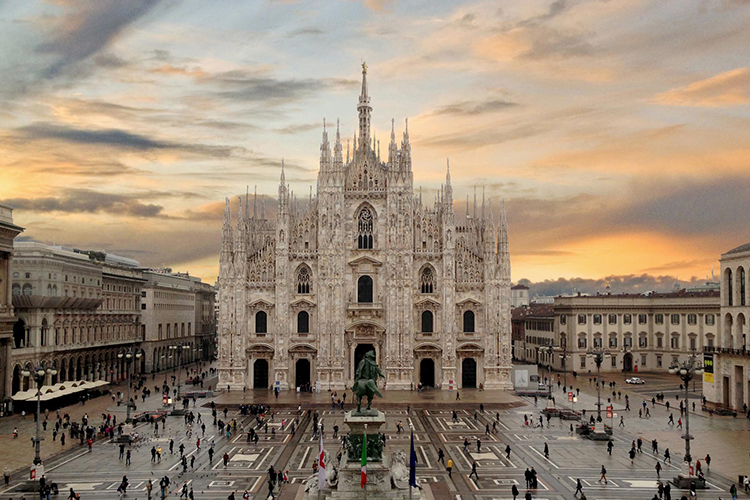
In the place where now stands the church were once the ancient cathedral of Santa Maria Maggiore and the Basilica of St. Thecla. After the collapse of the tower, bishop Antonio de’ Saluzzi, with the consent of the population, promoted the reconstruction of a new, larger cathedral which arose on the site of the oldest religious heart of the city. To take control of the work was the Lord Gian Galeazzo Visconti, by imposing a very ambitious project. The material chosen for the construction of the majestic building was the white marble of Candoglia and the architectural forms were that of the late Gothic-inspired Rhenish-Bohemian. The desire of Gian Galeazzo, in fact, was to give the city a magnificent building with the latest European trends, which would symbolize the ambitions of his state that in his plans, was supposed to become the center of an Italian national monarchy as it was successful in France and England.

The cathedral has two distinguishing features: the first is the compromise between Gothic verticality and Lombardy horizontality, the second is the abundance of sculptural decorations made between the fourteenth and twentieth centuries. Italian and foreign, renaissance and baroque, neoclassical and art deco artists took turns in the decoration of the Milan Cathedral. Among the most notable sculptures, we remember the monument to Gian Giacomo Medici by Leone Leoni which can be seen inside the cathedral in the right transept. The most famous work is the St. Bartholomew Flayed by Marco D’Agrate, representing the saint with the skin flayed carried on the shoulders like a stole.

With its fifty monumental stained glass windows, the cathedral is also an extraordinary testimony of the history of glass-making since the beginning of the fifteenth century to the late twentieth century. Over the centuries, Italian, Flemish and German glassmakers collaborated in their production. Suspended above the altar and enclosed within a large cross, it made visible through a red light always on, there is the Holy Nail, a kind of bridle of about 30 centimeters, the most precious relic of the cathedral, which was rediscovered by St. Helena and used by his son, Emperor Constantine, as the bite of his horse.

If you are in Milan, we suggest you do not miss the chance to visit the terraces of the cathedral, from which you can admire the dense forest of spiers, pinnacles, statues and flying buttresses, besides enjoying a splendid view of the city.


