In the heart of Tuscany, in the south-western end of Chianti, there is a magical, fairy-tale place, capable of taking anyone back in time, to the Middle Ages: it is Monteriggioni, a charming 13th century village. Ideal for planning a small holiday at any time of the year and to relive the grandeur and magic of another era.

Being close to Siena, San Gimignano and other places of inestimable historical value, Monteriggioni is a destination to plan at least once in your life. Because it allows you to visit one of the most beautiful areas of Tuscany.
The history of Monteriggioni
The origins of the village date back to the thirteenth century: between 1214 and 1219, the Sienese built the Castle of Monteriggioni in order to defend the center and control the surrounding territory. The peculiarity of this building is the circular layout of its walls, which follows the natural course of the hill, thus giving it a particularly irregular shape and very similar, in small, to that of the Wall of China.
In the beginning, the castle was surrounded by ditches, useful in case of siege, because they could be filled with coal and set on fire to avoid the arrival of enemies. Thanks to this system, Monteriggioni has long been an impregnable and unattainable village, so much so that its fall was possible only with a betrayal: the captain of the army, a Florentine escapee, in fact, decided to hand over the castle to the enemy Florence: without fighting.
From that moment on, Monteriggioni passed into the hands of the Signoria of Florence, specifically to Cosimo I de’ Medici, and its inhabitants became subjects of Florence.
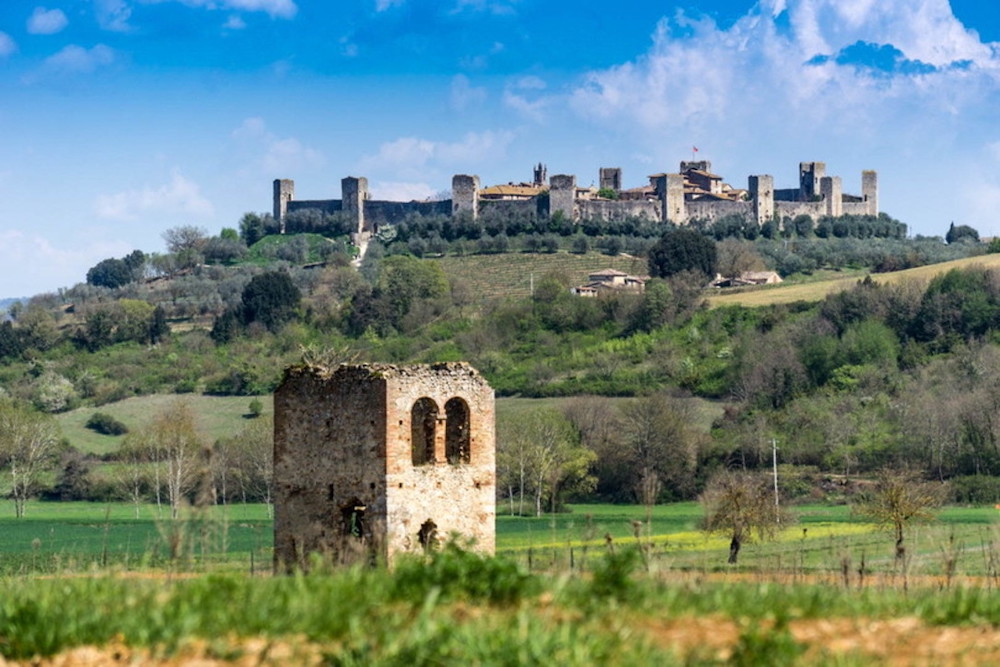
Even today, the walls of the castle look simply wonderful: this is due to the wise and important restoration work carried out between the twenties and thirties of the twentieth century, during which the previously demolished towers were also rebuilt.
Monteriggioni, therefore, is a fundamental place for all those who want to know the history of Tuscany and the many battles that took place here during the Middle Ages. The village has been included in the route of the Via Francigena, assuming a new importance, today tourist and no longer military as in the thirteenth century.
What to see in Monteriggioni
In Monteriggioni time seems to have stopped: the landscapes are those typical of a postcard, with a fairytale and dreamy air, with small houses and narrow streets that wind through the towers of the castle. That’s why inside (and not only) you can admire beautiful historical and architectural monuments, to be immortalized in extraordinary photo-memories!
The Castle of Monteriggioni
The Castle of Monteriggioni is the symbol par excellence of the village: built by the Sienese at the behest of Guelfo da Porcari, the Republic of Siena used it as a means of defense from enemy attacks. It is located, in fact, on Mount Ala, from which it offers a privileged view of the surrounding landscape and, above all, on the Via Francigena.
The structure has long been the subject of clashes between Sienese and Florentines; between the fifteenth and sixteenth centuries it became the headquarters of artillerymen, while today it is owned by the Griccioli family.
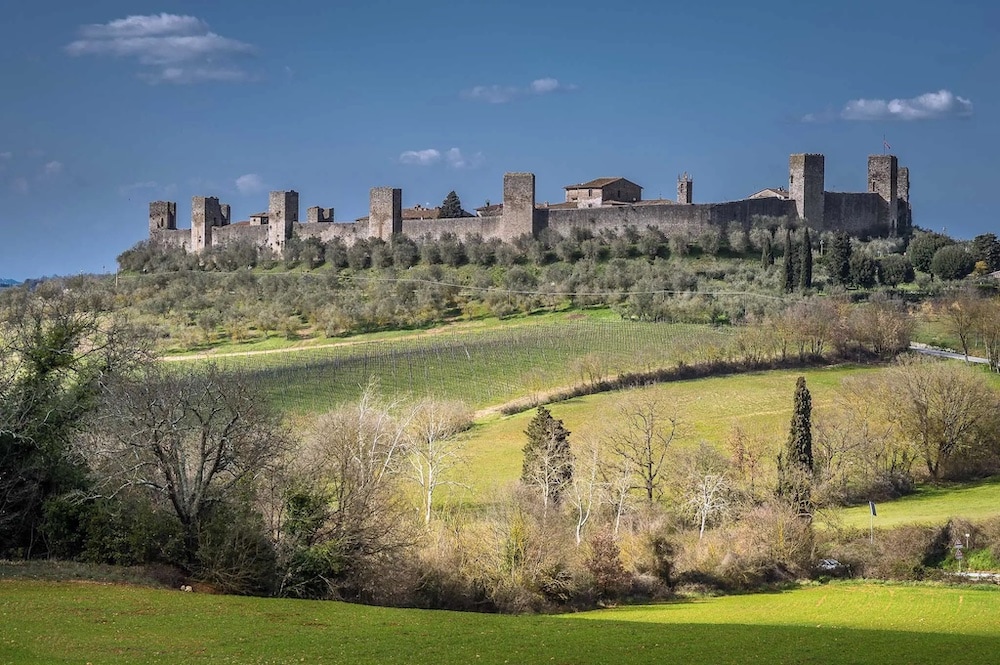
Monteriggioni is among the most beautiful and famous walled villages in Italy, whose interior dominate the slowness and harmony; the economy is based on agriculture and livestock, crafts and culture, and there is no frenzy typical of urbanized cities. In addition, it is the ideal place to enjoy typical local cuisine, of course at zero kilometer.
The Via Francigena
The Via Francigena that linked Rome to Northern Europe once passed through Monteriggioni. Also known as Via Romea, it is a set of paths that have become famous because they are crossed by pilgrims and crusaders heading towards the Holy Land; just think that in the Middle Ages the pilgrimage to Rome, especially to the tomb of the Apostle Peter, was continuous and many pilgrims continued beyond the capital to head to Puglia.

During this journey, Tuscany was a place of rest, in particular the province of Siena. Since 1994, the entire Via Francigena has become a real cultural itinerary, like the Way of Saint James of Campostela.
The City Walls
Among the main attractions of Monteriggioni is the Cinta Muraria, one of the most beautiful and characteristic examples of military architecture in the world. Built during the thirteenth century, it extends for 570 meters and was initially used to protect the village from Florentine attacks. At first sight, in fact, it almost seems that it embraces the entire village, together with its 14 majestic towers.

At the foot of the walls, instead, there was a swamp, reclaimed by the meticulous work of the monks, which now houses in its center the Tower of Reclamation complete with underground gallery.
Le Porte
Monteriggioni has several doors, each with its own characteristics, unique and wonderful to admire:
- Porta Franca, also known as Porta Romea, facing Rome, which allows access to the village;
- the West Gate, facing Florence;
- the Porta Murata, no longer accessible.
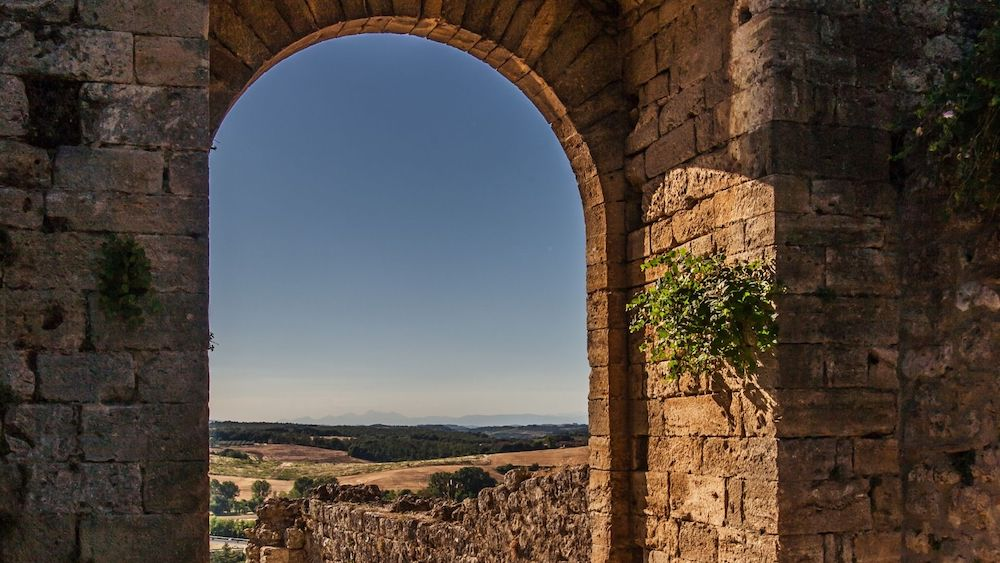
Porta Franca, Monteriggioni
Piazza Roma and the museums
The heart of Monteriggioni coincides with Piazza Roma, the point from which the entire urban nucleus develops. Since the village is not particularly rich in squares, Piazza Roma is called «la piazzetta». Here you can access through the medieval gates and you can visit the Tourist Office, the Museum of Arms and the Church of Santa Maria Assunta. There are also several bars and inns where you can refresh yourself during a walk.

Among the attractions of the place, the Museum of Monteriggioni in Arme is the main one: inside are exposed all the historical monuments of the village, including some explanatory models of medieval battles. A very interesting cultural experience, which allows you to discover the ancient local traditions.
What to do in Monteriggioni
In addition to its architectural equipment, Monteriggioni offers several activities to play, especially in the family, in the company of children, to spend a few hours of pure fun and relaxation!
Sport and nature
Among the first things to do once you reach the village is walking, following the entire urban perimeter and making a stop at the towers. The local museum and the tourist office often organize excursions and cultural walks to discover the city, just ask in time.

Lovers of sports and outdoor activities, however, can go hiking in the hills around and participate in mountain biking to admire the breathtaking views from above. A real full immersion in nature!
Local food and wine
As mentioned initially, Monteriggioni is the ideal place to taste the most popular local food and wine products ever: try first the sweet and sour, a dish made of sugar and lemon, followed by pork steak with turnips, thistles, stuffed onions, coratella of wild boar, bacon Maremma, fried pasta, pici with crumb sauce, tomatoes Mugello, sausages and cabbage soup.

In addition, the village is full of farms and wineries that organize delicious tastings of local wines such as Brunello, Chianti, Vernaccia and Vecchia Corona with the presidio of the best wineries in the area.
Hermitages and sacred places
Monteriggioni is not only a place suitable for nature, sport, culture and good food; to increase its inestimable value also contribute the many sacred places inside, such as the Hermitage of San Leonardo al Lago, Augustinian era, built in 1119.

Chiesa di Santa Maria Assunta, Monteriggioni
Monteriggioni is not only a place suitable for nature, sport, culture and good food; to increase its inestimable value also contribute the many sacred places inside, such as the Hermitage of San Leonardo al Lago, Augustinian era, built in 1119.
Other recommended mystical places are:
- the Pieve di Santa Maria a Castello, one of the most interesting symbols of Siena, as well as important evidence of the history and disputes inherent in the exchange of property of the Catholic Church. Restored in the nineteenth century and then slowly abandoned, today it is partly used as a farm;
- the Abbey of Saints Salvatore and Cirino, which in the past was responsible for the organization of all the other local churches, a symbol of pilgrims. It is located in the center of the fortified complex of Abbadia and houses many works of great value.
Events in Monteriggiano
Every self-respecting holiday also deserves healthy fun, which in Monteriggioni certainly does not miss! Despite the small size, the village organizes a large number of events to which you can participate throughout the year, from typical festivals to cultural tours around the country.
The most important event is, in any case, the Medieval Festival that takes place every year in July in a blaze of history, culture and food and wine. Founded with the aim of enhancing the local heritage and showing its culinary specialties, craftsmanship and traditional and popular works, it is able to attract visitors from all over the world. The focus is, of course, the Castle that welcomes citizens dressed in costumes of the time in an incredibly colorful and folk parade.
Visit the surroundings of Monteriggioni
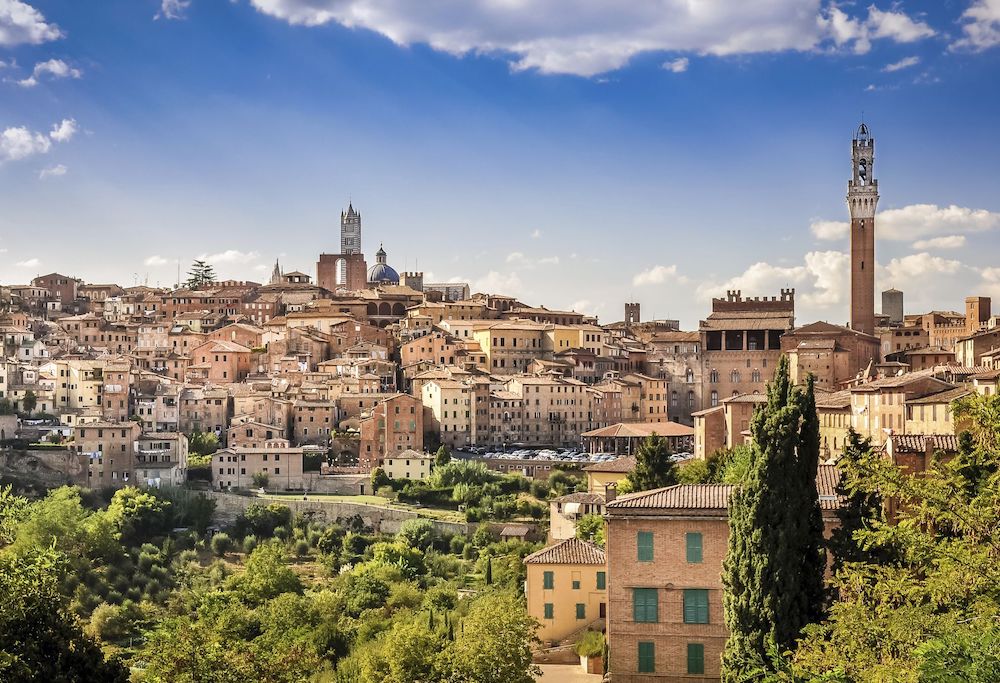
Monteriggioni is also a great starting point to visit other villages and other cities that are located nearby. An ideal tour could have as its first stop Siena, among the Tuscan cities rich in medieval buildings.

Next, the inevitable Montepulciano, which is irresistible for its wine tradition that offers visitors many tastings of the best local labels.

Also recommended is San Miniato, a town between Florence and Pisa, the most famous industrial area for the production of leather and wine and for the cultivation of white truffles. At the same time, you can also visit Arezzo and its immense cathedral.

Do not miss Montalcino, a characteristic small village famous for the production of Brunello wine, as well as San Gimignano, a UNESCO World Heritage site for its historic center.
From Monteriggioni you can easily reach Florence, to enjoy a day of culture, also taking a jump on the Florentine hills of Certaldo and Pelago, which offer unforgettable views.

Do not miss, finally, the many spas scattered throughout the territory, which allow visitors to relax and regenerate; the most beautiful are in Rapolano, in San Giovanni: they are totally natural, with water coming directly from the spring and hot pools, entirely surrounded by nature. Clear, fresh and sweet waters as Petrarch wrote in Canzoniere in the middle of the Middle Ages.
Copertina: toscana